
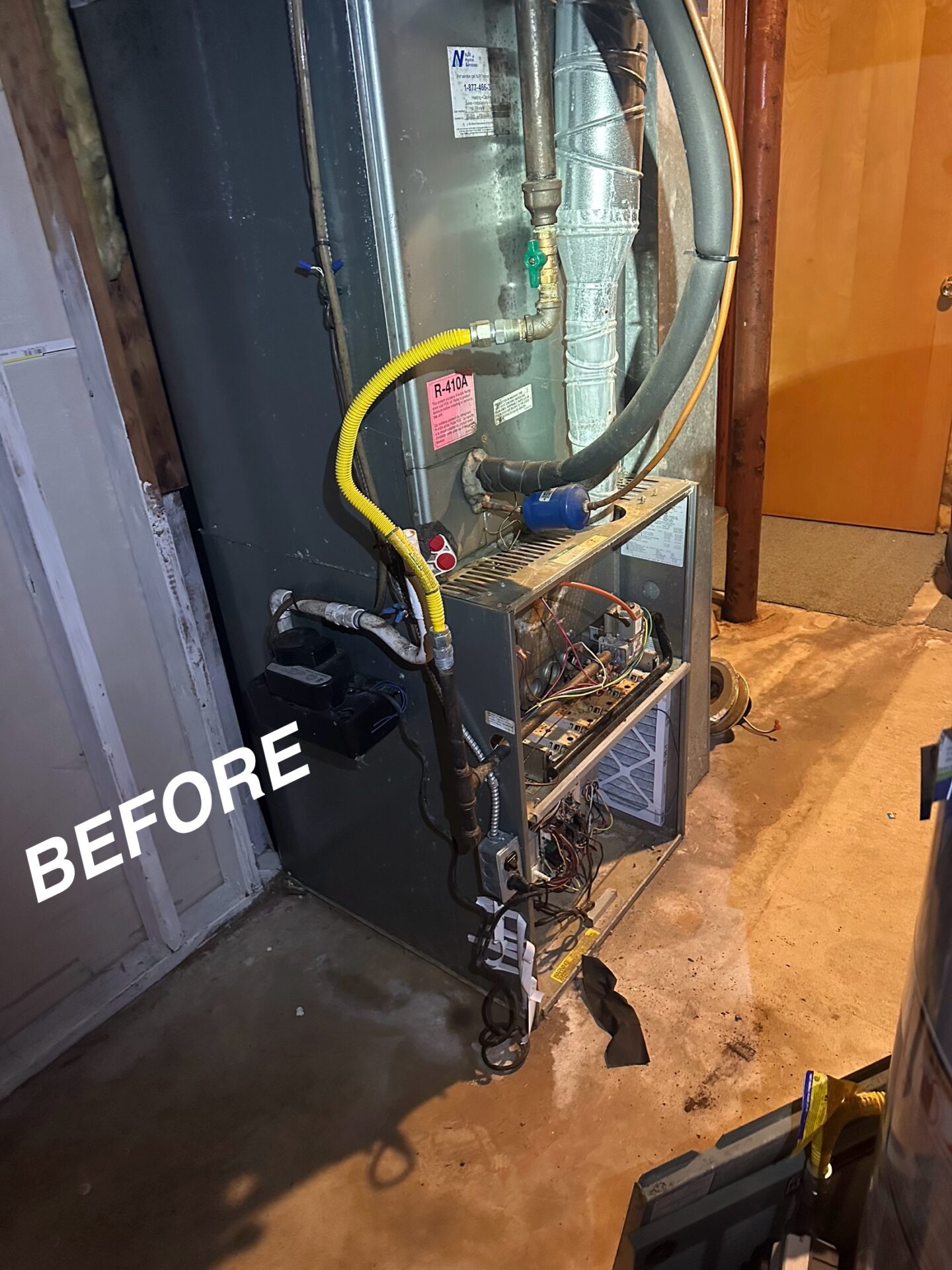
When a furnace quits in January, the question is never academic. Ocean County’s 99% heating design temperature is 14°F, the benchmark a properly sized system has to hold on the coldest stretch of a normal winter. A house without heat gets uncomfortable fast, and pipes start to matter within hours.
We repair gas and electric furnaces throughout Toms River and Ocean County. Below is what we actually check, what the common failures are, and how we decide with you whether a repair is worth making.
Signs your furnace needs attention
- It takes several attempts to light, or lights and then cuts out after a few seconds
- Short cycling: the burner runs briefly, shuts off, and restarts repeatedly
- Cold air from the vents while the system claims to be heating
- New noises: grinding, squealing, a boom on ignition, or persistent rattling
- Rising gas usage against similar weather
- Uneven temperatures between rooms that used to be consistent
- The carbon monoxide alarm sounds: leave the house and call from outside
A delayed ignition that ends in a small boom is worth taking seriously rather than living with. It usually means gas is accumulating before it ignites, and the cause needs finding.
What we check on a no-heat call
A furnace has a fixed sequence of operation, and a fault almost always interrupts it at a specific point. Diagnosis is a matter of following that sequence rather than guessing.
The cheap things first
A surprising share of no-heat calls come down to a clogged filter restricting airflow and tripping the high-limit switch, a thermostat problem, a tripped breaker, or a condensate drain backing up and triggering the safety float. We check these before anything else, and if that is all it is, we tell you so.
Ignition and flame
Hot surface ignitors fail regularly. They are a consumable part. Flame sensors oxidize and stop proving flame, which makes the burner light and shut down a few seconds later, over and over. Both are common, inexpensive and fast to put right.
Pressure switches and venting
On a condensing furnace, the intake and exhaust usually terminate through a sidewall. Snow drifting against them, ice at the terminations, or a blocked condensate line will shut the furnace down on a pressure switch fault. In a coastal climate the flue components also corrode faster than inland, so we inspect them rather than assume.
The heat exchanger
This is the inspection that matters most for safety. A cracked heat exchanger can let combustion gases into the air you breathe, and carbon monoxide gives no warning by smell. If we find a crack we will tell you plainly, and we will not return the system to service.
Blower and electrical
Capacitors, blower motors, control boards and limit switches are all normal wear items. On a system in otherwise good condition, none of these is a reason to replace the furnace.
Repair or replace?
We would rather give you the arithmetic than a sales pitch.
Under about ten years, repair is usually right. The equipment has life left and most failures at that age are single components.
Beyond about fifteen years, replacement usually is, particularly if the repair is expensive or the system has already needed work more than once.
In between, it depends on the specific fault and the condition of the rest of the system. A cracked heat exchanger on a fourteen-year-old furnace is a replacement conversation. A failed ignitor on the same furnace is a repair.
One local wrinkle worth knowing: our winters are long and mild rather than severe, so furnaces here cycle on and off constantly from October into April instead of running steadily. Cycling is what wears ignitors, flame sensors, pressure switches and blower motors. An oversized furnace cycles more and wears faster, which is why sizing matters at replacement time. Our guide to getting a heating system ready for a Jersey Shore winter goes into this in detail.
How we work
We diagnose before quoting. You get told what failed, what it costs to put right, and what we would do in your position, including when the answer is that the system is fine and needs nothing.
We are a licensed New Jersey HVACR contractor and we carry the insurance the state requires. If you want to check that before letting anyone into your house, you should. Our article on how to choose a licensed HVAC contractor in New Jersey explains exactly how, and it applies to us as much as to anyone else.
Where we work
Furnace repair across Toms River, Brick, Lakewood, Jackson, Manchester, Berkeley, Beachwood, Bayville, Forked River, Island Heights, Pine Beach, Barnegat, Whiting and the surrounding Ocean County communities.
Call us about a furnace problem, see recent work, or read the five signs your HVAC system needs repair.